
| |
| Home Page |  |
| My Music | |
| Buy my CD | |
| Pictures | |
| Awards | |
| Guestbook | |
| |
| Links | |
| WebRings | |

There have been numerous discussions about capos in the RMMGA newsgroup on Usenet. A frequently made comment is that capos can pull the guitar out of tune because they exert so much pressure on the strings. It is not so bad with all capos, there are some whose pressure can be adjusted, like the one made by Schubb. There is one other popular capo, namely the one made by Kyser, which is not so good in that respect. Its pressure, coming from a powerful steel spring, is particularly high, and it cannot be adjusted either.
What's worse, the guitar's pitch is not raised evenly - strings go out of tune by different margins. This is because strings have different diameters and varying stiffness, so they yield to the pressure applied by the capo in an uneven way.
Still, Kyser capos are very popular, because their operation is so reliable and hassle free. It goes on in two seconds, it changes position in one second, strings never buzz, and it does not get in the way of the player's left hand under the neck. I use Kyser capos myself.

I have come up with a simple modification of the Kyser capo to alleviate the detuning effect. It consists merely of a strip of heavy paper which is placed under the strings where the capo is placed. Just cut a strip of paper and fold it into an L-shape (A). Use a piece of scotch tape (B) to attach the paper strip to the capo. Then, when mounting the capo, slide the paper under the strings.
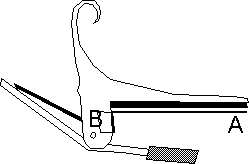
It will take some practice, but eventually you will be able to mount the capo just as quickly as before. Also, the paper strip needs frequent replacement.
What the paper strip does is preventing the strings from being pressed all the way down to the fretboard. Obviously the paper has to be thick enough to have any effect, but still somewhat thinner than the fret wire, so the strings don't buzz. You will have to experiment with papers of different thickness until you find one that works best for you.